Positioning
Acquisition marketing in 2026: why being found now means being recommended
Acquisition used to mean ranking in search results. Increasingly it means being one of three names an AI platform returns. Same goal, different mechanism — and most businesses have not noticed the change.
What changed
People increasingly do not browse a page of options. They ask an AI platform — ChatGPT, Google AI Overviews, Gemini, Perplexity — for a recommendation, and get three or four names back.
Traditional search returns a list and lets the customer choose. AI platforms make the shortlist and present it as a recommendation.
That removes the browsing step entirely. A customer who would once have compared ten businesses now sees three. The other seven were not beaten — they were never in the room.
Which means the definition of visible has changed. Ranking eighth used to mean being findable. Now it means being invisible.
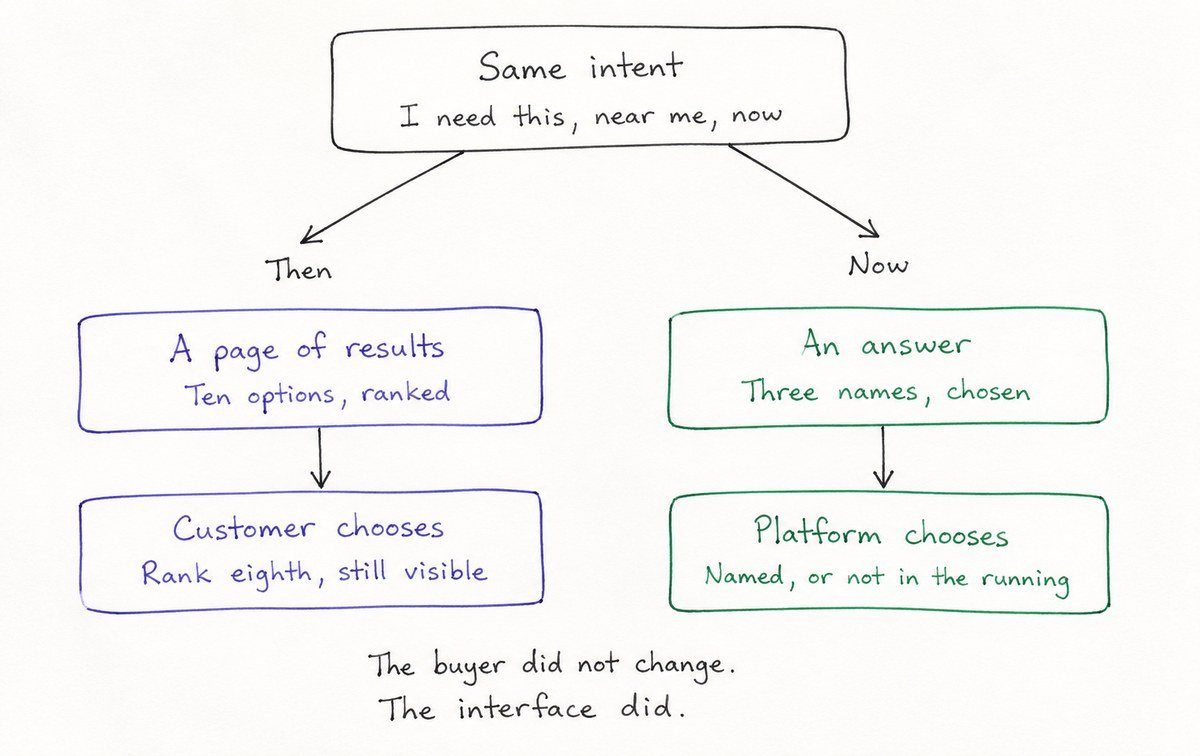
Search intent has not changed. The interface has.
Someone who needs a physio in Bondi still needs a physio in Bondi. The intent is identical. What has changed is what happens after they ask.
This is why the term acquisition agency is still the right one — an agency whose job is to bring in paying clients rather than followers, reach or impressions, working at the moment someone decides rather than the moment they first hear your name.
The goal has not moved. The route to it has.
How clients used to arrive from search intent
Until recently the route was clear: appear high in the results when someone searched for what you do.
- Rank in the map pack for your service and suburb
- Optimise the Google Business Profile
- Collect reviews and keep the rating high
- Convert the click into a call or booking
The customer typed a query, received a page of options, and chose from them. Your job was to be on that page and to look like the best choice on it.
How clients arrive from search intent now
Same person, same need, same urgency. But they ask a question and receive an answer — so there is no page to appear on, and no list to be ranked within.
- Be described consistently everywhere a machine can read you
- Have a page for each service, in the words customers actually use
- Publish content that answers real questions, so it can be cited
- Structure the site so platforms can read facts rather than infer them
- Measure how often you are named, and improve it
The intent has not changed. You are still working at the moment someone decides. The mechanism has changed entirely.
Search versus AI recommendation
| Traditional search | AI recommendation | |
|---|---|---|
| What the customer gets | A page of options | Three or four names |
| Who decides the shortlist | The customer | The platform |
| What visible means | Appearing on page one | Being named in the answer |
| What matters most | Rankings and proximity | Clarity and consistency |
| Second page | Some traffic | Does not exist |
Why AI platforms recommend some businesses and not others
This is the part that surprises people, because it has little to do with how good the business is.
AI platforms describe a business the way the business describes itself.
If your website, Google Business Profile, booking system and social profiles all describe you the same way, the platform builds a confident picture of what you are and recommends you accordingly.
If they conflict — and they usually do — confidence drops. And when a platform is uncertain, it recommends a business it is more certain about.
We have measured businesses with five-star reputations and hundreds of reviews scoring near zero on AI visibility, while competitors with worse reviews get named every time. The difference was not quality. It was legibility.
The two-question test
Sixty seconds, and you can run it right now.
1. Google your business name. Are you proud of what comes up?
2. Ask ChatGPT to recommend a business like yours in your city. Are you in the answer?
Almost everyone passes the first. Almost nobody passes the second. The gap between those two answers is the work.
What this means practically
The fundamentals have not been replaced. A complete Google Business Profile, genuine reviews and strong local ranking still matter — they are among the sources AI platforms read when deciding what to recommend.
What has been added is a requirement for consistency and structure:
- One description, everywhere. The same words on your website, Google profile, booking system and social bios. Not similar — identical.
- A page for each service, written in the language customers actually search rather than industry terminology.
- Structured data so platforms can read your services, location and credentials as facts rather than inferring them from prose.
- Content that answers real questions, because question-shaped content is what gets cited.
- Measurement. You cannot improve what you have not scored.
How Sovier works
Sovier is a Melbourne-based agency specialising AI search visibility and local SEO for wellness, beauty and lifestyle brands.
We start by measuring: six questions your customers would actually ask, across four AI platforms, scored out of twenty-four. That number is the baseline, and it is what we measure against afterwards.
Then the work — Google Business Profile optimisation, entity consistency across every platform, structured data, site architecture, and content built around what people search rather than what the industry calls it.
We work primarily in categories where paid advertising is restricted. Wellness practitioners, cosmetic clinics, intimate wellness and sexual health brands regularly have ad accounts rejected and posts suppressed. For those businesses, organic discovery is not one channel among several. It is the only one that cannot be switched off overnight.
What we will not promise
Number one rankings. Guaranteed AI mentions. Results in month one.
Search engines and AI platforms are third parties that change without notice, and anyone promising otherwise is selling something they do not control.
What we promise is the strongest possible foundation, consistent execution, and honest reporting — including the months where nothing moves.
What does AI say about your business?
Six questions, four platforms, scored out of 24. It takes us about ten minutes and there is nothing attached to it.
Get your free AI Search scoreFrequently asked questions
What does acquisition mean in marketing?
Acquisition means the act of getting or obtaining something. In marketing, the thing being obtained is clients — so client acquisition is the work of bringing in paying customers, as distinct from awareness work, which makes people aware a business exists without necessarily converting them.
What is an acquisition agency?
An agency focused on generating paying clients rather than brand awareness, working at the decision stage and measuring success in bookings rather than impressions. The intent has not changed; the mechanism has.
What is AI search visibility?
How often AI platforms name your business when someone asks for a recommendation in your category. Unlike traditional search, these platforms typically return three or four names — you are either in the answer or you are not in the running.
Is local SEO still relevant?
Yes. Google Business Profile, reviews and local ranking are among the sources AI platforms draw on. Local SEO has not been replaced — it has become the foundation for something built on top of it.
How do I know where I stand?
Run the two-question test above. If the second answer stings, that is the gap, and it is measurable.